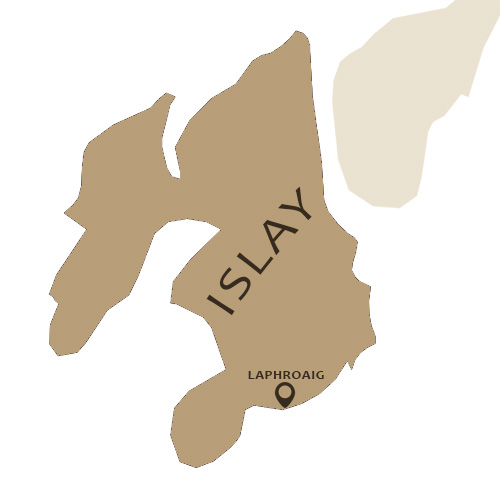
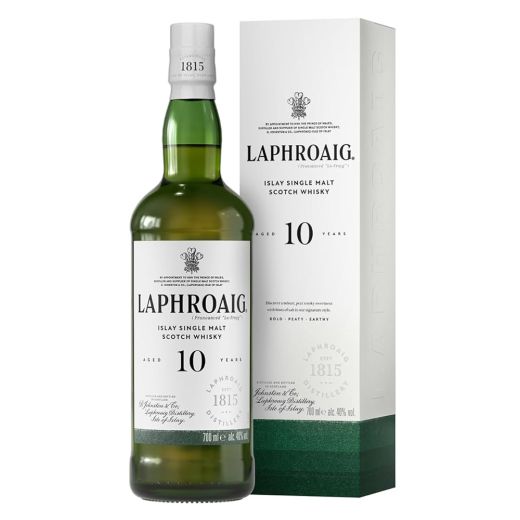
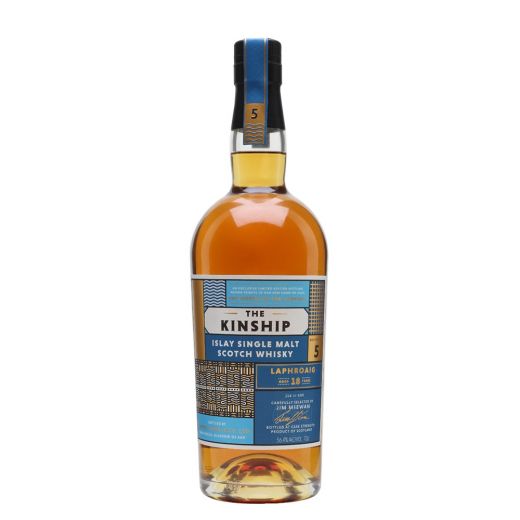
We are on the island of Islay, where on fine days you can make out the coast of Northern Ireland from the distillery's bay — though the weather here is not always fine. Here, the power of the sea and the lashing of the wind help the work of the casks, creating a whisky of unique character. Here, one of the world's most admired Single Malt Scotch whiskies has been made for over 200 years. Here, we are at Laphroaig.
Founded in 1815 by the brothers Alexander and Donald Johnston — two Islay farmers — the Laphroaig distillery was only officially registered in 1824. In 1836 Donald Johnston bought out his brother's share and became the sole owner of the distillery; ten years later Donald died in a tragic accident at the distillery (he accidentally fell into a fermentation vat) and it passed to his eleven-year-old son Dugald. The distillery was then run by Dugald's uncle and by Walter Graham of nearby Lagavulin until the rightful heir came of age.
In the early twentieth century the distillery was still owned by the Johnston family and was run by Ian Hunter, Donald's great-grandson. Ian was a true visionary, the first person to grasp the market potential of single malts; for Ian, Laphroaig was not merely an "ingredient" for blends but a whisky to be sold under its own name. In 1908 Ian took over the distribution of Laphroaig (it had been handled by Peter Mackie, who also managed the distribution of Lagavulin) and by 1924 Laphroaig was sold all over the world, the United States included. Indeed, despite Prohibition coming into force (1920-1933), Laphroaig obtained a licence to be sold as an "alcoholic medicine" — the peaty, phenolic aroma of Laphroaig had probably convinced American customs to class it as a medicinal product.
In 1954 Ian Hunter died and, having no children, he left the distillery to his secretary Elizabeth Leitch "Bessie" Williamson. Bessie began working as a secretary at Laphroaig in the early Thirties and, thanks to her intelligence and her passion for whisky, she became year after year a point of reference (helped too by Hunter's frequent trips abroad). Bessie remained at the head of the distillery until the early 1970s, when Laphroaig needed heavy investment to keep pace with the times and was sold to the Americans of Long John Distillers. During Bessie's years as managing director Laphroaig continued to grow and prosper, and by 1972, the year she retired, the distillery was equipped with 7 stills: 3 wash stills and 4 spirit stills.
In 1994 the distillery received an official visit from His Royal Highness Prince Charles, and at the end of the visit the Prince granted Laphroaig the title of "Royal Warrant by Appointment". This title is awarded to those who supply goods to the Royal Family; it is a prestigious distinction that also allows the royal coat of arms to be used on the company's products. Prince Charles's visit was repeated in 2008. 1994 was also the year the "Friends of Laphroaig" club was created, the first association set up by a distillery in the modern era. Members are entitled to a lifetime lease on a "plot", one square foot of land on the island of Islay, and to a free dram each year when they visit the distillery.
In the 2000s the distillery was owned by Allied Distillers, but in 2005, with the merger between Allied Distillers and Pernod Ricard, the British competition authority required the group to sell a distillery. The choice fell on Laphroaig, which that same year was sold to Beam Suntory (at the time simply Jim Beam), still its owner today.
In 2001 Laphroaig overtook Lagavulin in single malt sales, taking first place as the best-selling single malt on Islay and ranking 7th among the world's best-selling single malts.
Laphroaig is currently one of the few distilleries still operating its malting floor, producing in-house around 20% of its requirement of malt peated to 40-60 ppm, with the remainder bought from the Port Ellen maltings. Its equipment includes 6 stainless steel washbacks with an average fermentation of between 50 and 55 hours, while the stills are the same as in 1972 and, curiously, number 7: 3 wash stills and 4 spirit stills. Annual production (2017) is 3.3 million litres of alcohol.
Did you know? Laphroaig still has its own private peat bog, and the peat is still cut by hand, because the distillery is convinced that machines compress the turf too much, causing it to lose some of its aromas.
Around 70% of the spirit is bottled as single malt, while the other 30% is sold for blending.
 en
en
 WI IT
WI IT